
Yoshimura History -33
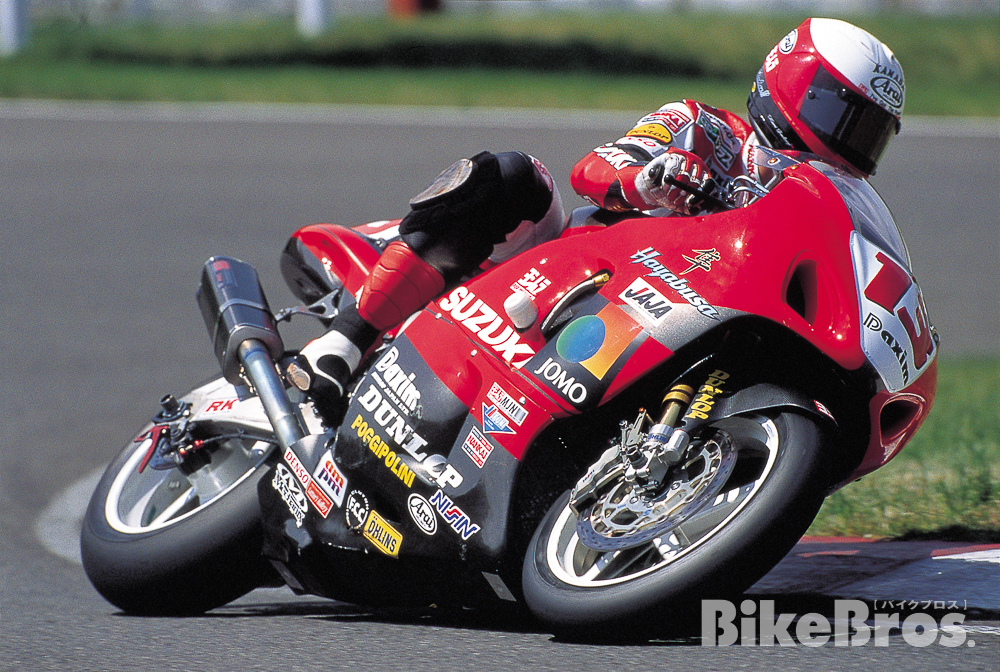
#13 Manabu “Gaku” Kamada overpowers the relatively bulky, unwieldy Yoshimura Hayabusa in the 1999 All-Japan Championship. He claims the S-NK class championship. Photo courtesy of Yoshimura Archives.
In 1999, Yoshimura made a major move. They decided to compete in the S-NK (Super Naked) class –––– rather than the Superbike class –––– in the All-Japan Road Race Championship and the Suzuka 8 Hours. The base machine was the Suzuki GSX1300R Hayabusa.
Yoshimura History #33: X-Formula Hayabusa Takes Off
1999-2000: Unleashing the Superpower of ‘Busa.
The S-NK class was established in 1997 and consists of two subclasses: NK1 (large naked bikes with steel frames, 750cc or more for 4-cylinder models) and X-Formula (800cc or more for 4-cylinder models, up to 1350cc by boring out), both based on production motorcycles. Entrants who finished in the top six could purchase the winning machine, with the price set at 3.5 million yen for NK1 and 2 million yen for X-Formula.
The S-NK category was set for the All-Japan series and the Suzuka 8 Hours. In 1998, points in the All-Japan series were awarded based on overall finishing order in races where S-NK bikes competed alongside Superbikes; however, starting in 1999, finishers began receiving points specific to the S-NK class (the number of points awarded varies depending on the number of entries in the qualifying round). As a result, an All-Japan S-NK class champion will now be crowned. Also, at the Suzuka 8 Hours, the S-NK class awards ceremony is now held separately from the overall awards ceremony.
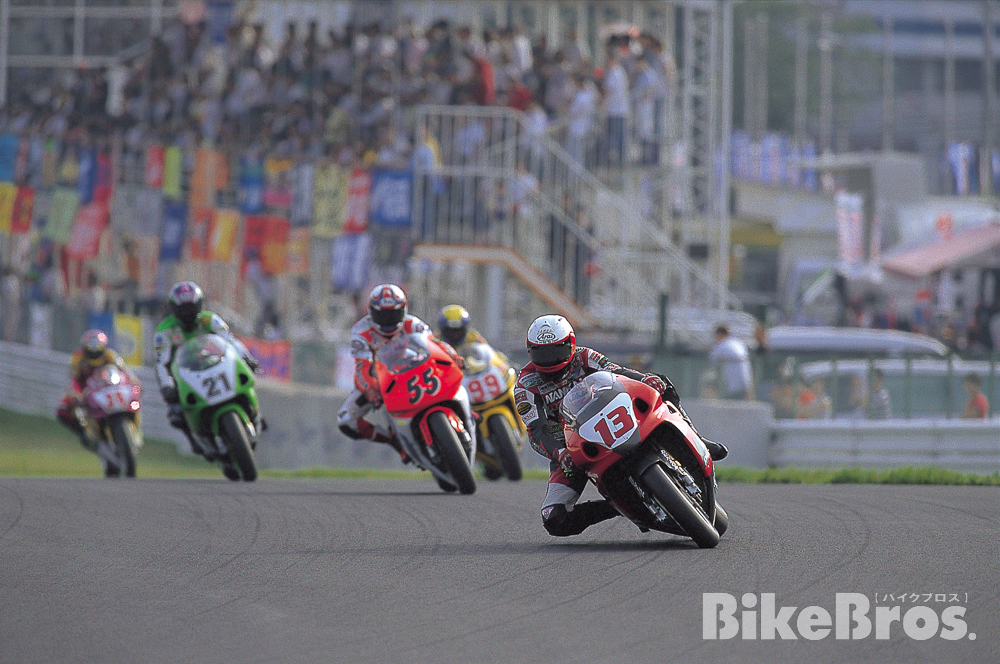
#13 Kamada approaching Turn 1 at Tsukuba during Round 8 of the All-Japan Championship on September 19, 1999. The S-NK class was racing alongside the Superbike class, with #55 Nukumi (Sakurai Honda, Honda RC45 superbike), #21 Shimizu (Team Green Kawasaki ZX-7RR superbike), and #99 Tsuruta (Yellow Cone Kawasaki ZX-9R superbike) chasing Kamada. Photo courtesy of Yoshimura Archives.
Although the weight limits and other regulations for Superbike racing at the time differed slightly among the MFJ (All-Japan), AMA and FIM (WorldSBK), the displacement limits were the same across them: 600-750cc for 4-cylinder engines, 600-900cc for 3-cylinder engines, and 750-1000cc for 2-cylinder engines. The Hayabusa has a displacement of 1298cc, which exceeds the Superbike regulations, but it is eligible to compete in the X-Formula class established for the All-Japan Championship and the Suzuka 8 Hours. In the United States, it could compete in the AMA Formula Xtreme series and WERA’s open-class Formula USA series. WERA (Western Eastern Roadracers Association) is a nationwide organization in the U.S. that has a stronger amateur focus than the AMA, yet the number and scale of its races are extensive.
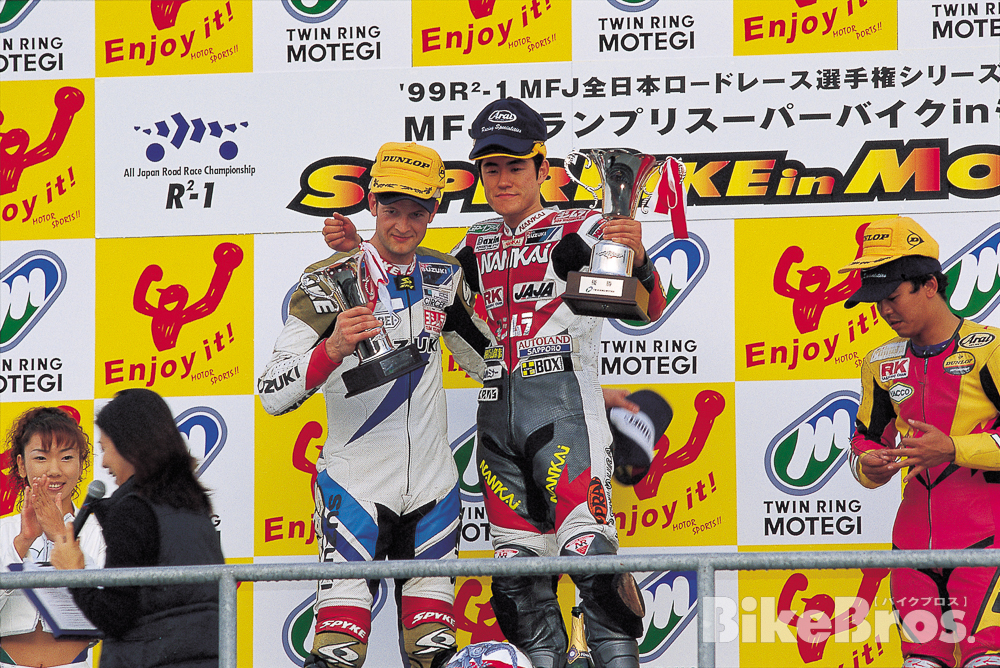
Manabu Kamada (center) and Terry Rymer (left) sharing their joy on the podium. Yoshimura Hayabusa entered the final round of the 1999 All-Japan Championship, the MFJ Grand Prix at Motegi on November 7, with a two-bike lineup featuring #13 Kamada and #43 Rymer, securing a 1-2 finish in the S-NK class (16th and 17th overall). Photo courtesy of Yoshimura Archives.
Fujio Yoshimura had initially planned to compete in the 1999 All-Japan Superbike Championship with the GSX-R750. However, one motorcycle caught his eye: the GSX1300R Hayabusa. The Hayabusa was unveiled in September 1998 at Intermot show in Germany and went on sale the following year as the “ultimate sports bike for the road.” It was a mega-sports bike powered by a water-cooled inline-four DOHC 16-valve engine with a bore and stroke of 81x63mm and a displacement of 1298cc, delivering a maximum output of 175 hp. With a verified top speed of over 300km/h, it stood apart from the supersport bikes that served as the base for superbikes, establishing itself as the fastest and most powerful production motorcycle available.
The dream of a racing motorcycle constructor is likely to race with a machine built freely in pursuit of their ideals. At least, that was the case at Yoshimura. How wonderful it would be if engines could be modified without restriction –––– not just in terms of displacement, but in every aspect –––– and if the chassis could also be built freely. Perhaps the only things that need to be regulated are safety standards and fuel capacity, which effectively limits maximum power output due to fuel efficiency demands…. Although the 1970s AMA Superbike series had modification rules (displacement limited to 1000cc or less, and chassis modifications restricted to reinforcing the stock frame), it offered far more freedom than the Superbike series in 1999. Above all, the passionate spirit and energy pulsing through Southern California –––– where many tuning specialists gathered –––– to “build something amazing” was a perfect fit for Yoshimura, and Fujio found it incredibly inspiring. That passion resonated with motorcycle fans, fostering a culture of building “hot bikes” modified with exhaust headers, high-lift cams, big bore kits and performance carburetors.
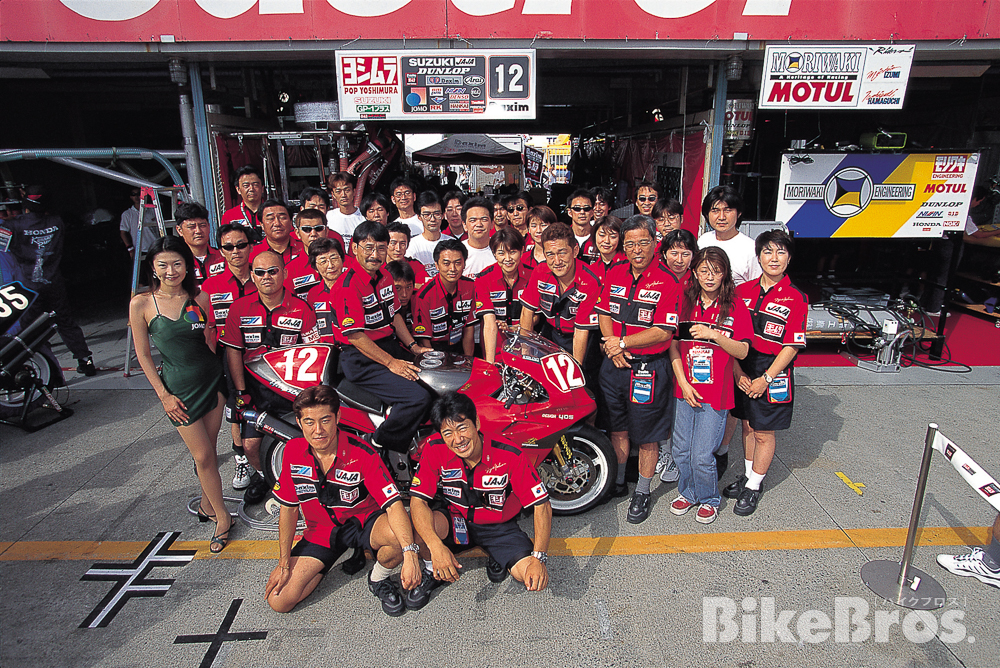
Team Yoshimura Suzuki GP1 Daxim, all set for the 22nd Suzuka 8 Hours in 1999. Manabu Kamada (left) and Naoto Ogura (right) crouching in front of the Hayabusa, astride by Fujio. The adjacent pit belonged to Moriwaki, which also competed in the S-NK class with a Honda VTR1000F. It had been a tradition since the inaugural 1978 event for the Yoshimura and Moriwaki families to compete together at the midsummer Suzuka race. Photo courtesy of Yoshimura Archives.
Do Yoshimura product users and racing fans really want to keep watching races featuring the Yoshimura Suzuki GSX-R750? Especially when there are more powerful, higher-displacement, and more exciting bikes out there…. Of course, aiming for the top-tier Superbike title in the All-Japan series makes sense, but there was something even more important for Yoshimura. And so, Fujio chose the Suzuki Hayabusa and decided to compete in the X-Formula series. After that, Yoshimura raced with the Hayabusa for two seasons, in 1999 and 2000.
However, as was expected, the Hayabusa was vastly different from the supersport models typically chosen as base bikes for Superbike racing. For one thing, the Hayabusa is bulky and heavy. Its 1480mm wheelbase and 217kg dry weight are necessary for stability at speeds exceeding 300km/h, and it is actually quite lightweight for a mega-sport bike with an engine displacement exceeding 1000cc. However, when it comes to building a race bike, it’s a different story. Take the 1999 GSX-R750, for example: with a 1395mm wheelbase and a dry weight of 178kg, it is indeed compact and lightweight, making it ideal for use as a race bike. The Hayabusa’s lean angle may be fine for highways, but it just isn’t enough for racing speeds on a track. Furthermore, due in part to its longer wheelbase, it also lacks maneuverability. And the final straw is its weight. As a racing bike, it had a ton of disadvantages.
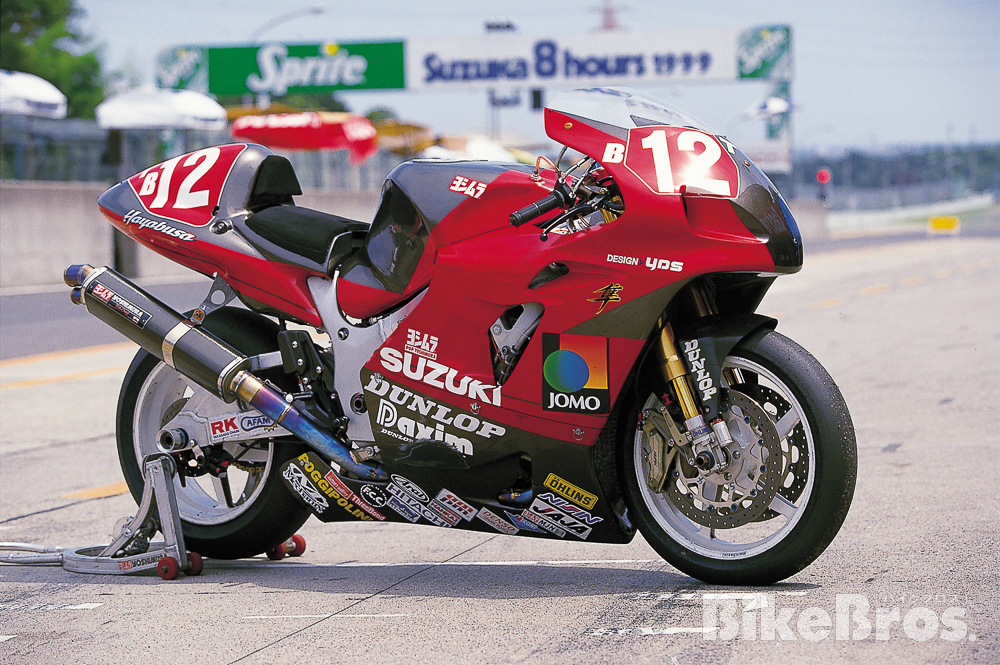
The Yoshimura Hayabusa getting ready for the 1999 Suzuka 8 Hours. Even after moving to the S-NK class, it retained the #12 race number, and the blue headlight is also a tradition. Note that at this point, the swingarm pivots were non-adjustable. Photo courtesy of Yoshimura Archives.
For the Hayabusa modifications, the main frame was left stock for the 1999 season, while the front forks were replaced with a set of 46mm Öhlins, the rear shock with an Öhlins TTX, the swingarm with a Suzuki factory-made piece for the GSX-R750 (with a shorter overall length than the original) and the suspension link with special-made parts. Particularly, the front forks provided increased rigidity, while the suspension links and swingarm led to improved traction and cornering performance.
One of the unique appeals of the X-Formula is the freedom it offers for chassis modifications. On the Yoshimura Hayabusa for the 2000 season, aiming to improve cornering performance and road feel, the section housing the steering head bearings was cut away and replaced with a billet piece welded in place, thereby steepening the rake (reducing the steering head angle). This increased the front-wheel load distribution and shortened the wheelbase. Also, the left and right swingarm pivot points were hollowed out, and billet parts featuring a mechanism allowing the pivots to move freely in front-back and left-right directions were welded into place. This mechanism enables proper pivot angle (swingarm hanging angle) adjustment, correcting the previously excessive pivot angle that had resulted from raising the ride height via the rear shock and linkage to increase the lean angle.
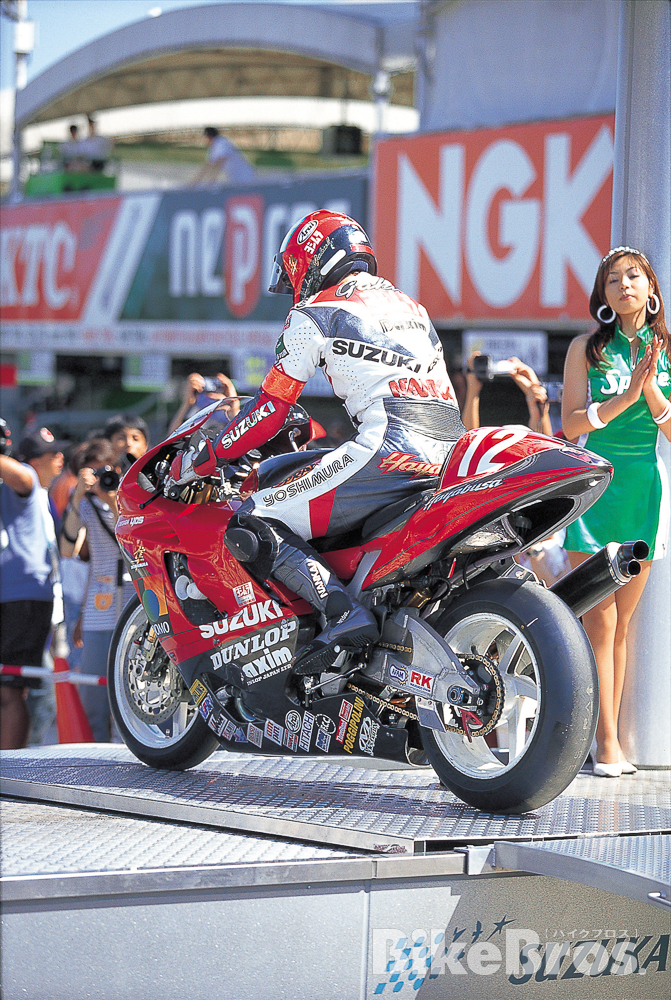
Another highlight of the 1999 Suzuka 8 Hours was Saturday’s Special Stage, where each bike started from an elevated platform set up on the pit lane. #12 Kamada received significantly louder cheers, clearly demonstrating the high expectations fans had for the Yoshimura Hayabusa. Photo courtesy of Yoshimura Archives.
The already powerful engine had its maximum output increased from 175ps to over 200ps. Modifications to the engine itself are extensive and include high-compression forged pistons (up from the original 11:1 to 12:1), high-lift cams, cylinder head tuning, reinforced connecting rods (the 2000 model uses Carrillo rods), a special crankshaft (with counter-balancer delete), a close-ratio gear kit, and a lightweight drilled shift drum.
For the electronic fuel injection system, the 1999 model featured a stock setup (with a single injector in each intake port), but the 2000 model adopted a dual-injector setup –––– similar to that used on the GSX-R750 superbike –––– with a total of two injectors: one in each intake port and one in each air funnel upstream of the throttle valve. The upstream injector is configured to deliver fuel only at high RPM, which is effective for improving high-RPM acceleration and boosting power output.
To manage the increased heat generated by the power upgrade, the bike was equipped with two large radiators –––– one above the other –––– that occupied most of the front opening in the fairing, as well as an air-cooled oil cooler (originally for Toyota Supra) mounted behind and to the right of them. For the 2000 model, a water-cooled oil cooler (combining the main unit from the Yamaha YZF-R1 with a machined aluminum base made by Yoshimura) was added to the upper left side of the crankcase.
In the 1999 All-Japan S-NK class, Yoshimura raced alongside the Yellow Cone Kawasaki ZX-9R, the BEET Kawasaki ZX-9R, and the OVER deLIGHT Yamaha YZF-R1. Yoshimura fielded Manabu Kamada as its ace rider, who won six of the ten races and successfully claimed the S-NK class championship. The team also fielded Naoto Ogura and Terry Rymer as one-off riders.
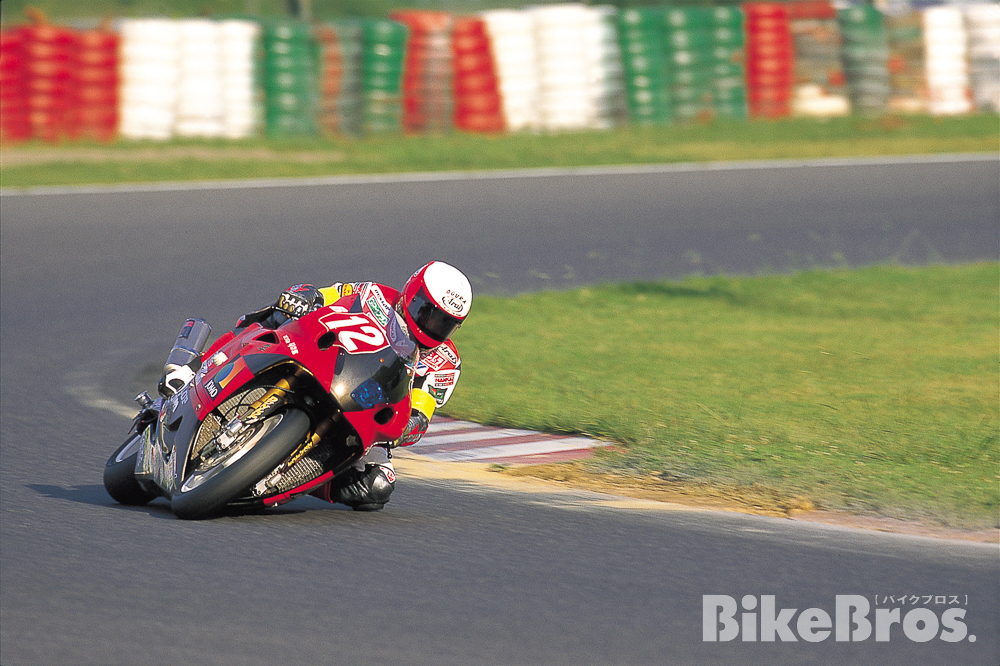
Although Ogura was not a full-time rider in the 1999 All-Japan series, he skillfully handled the bulky, heavy Hayabusa at the Suzuka 8 Hours. Photo courtesy of Yoshimura Archives.
Yoshimura entered the 1999 Suzuka 8 Hours with the Kamada / Ogura duo, qualifying 15th (2:12.450, 3.240 seconds behind pole position). While they were overwhelmingly fast on the straights, they simply couldn’t match the superbikes in braking and cornering. In the race, they completed 199 laps (14 laps behind the leader) and finished 16th overall, winning the S-NK class (the highest-placed X-Formula entry). Moriwaki also competed in the Suzuka 8 Hours S-NK X-Formula category with a Honda VTR1000F. The Nojima Kawasaki ZXR1100 in the S-NK NK1 category was also a major talking point.
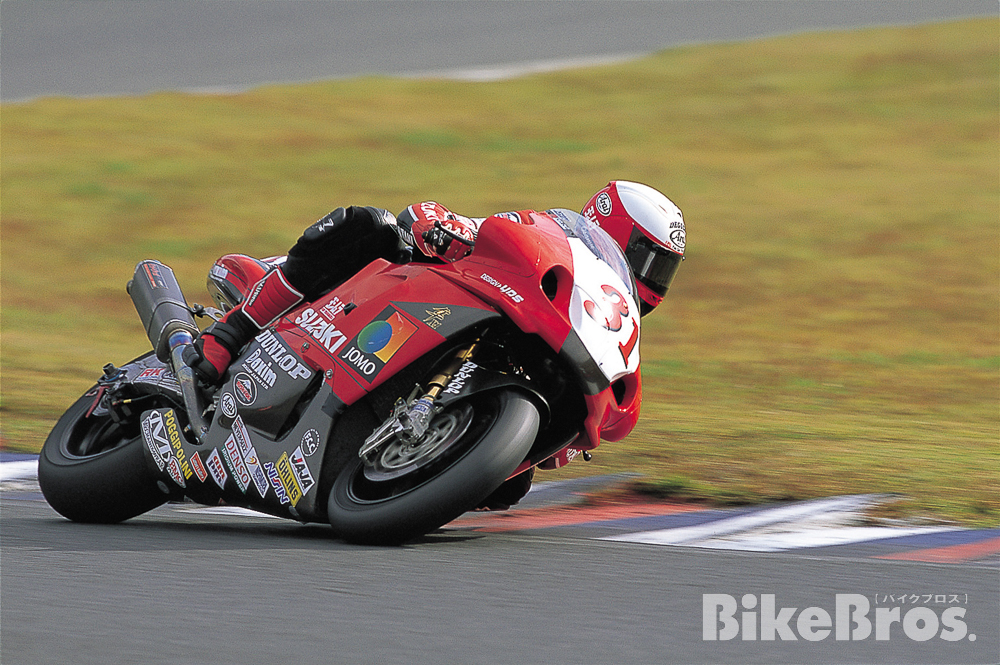
Osamu Deguchi masterfully riding the #31 Yoshimura Hayabusa at an All-Japan Championship race in 2000. He narrowly missed out on the title, finishing second in the season standings. Photo courtesy of Yoshimura Archives.
The 2000 season began with a tragedy. During the preseason tests at Suzuka in March, Naoto Ogura lost his life in an accident. A sense of profound loss and despair washed over everyone, but the season would not wait. Yoshimura competed in the All-Japan Championship with Osamu Deguchi and finished second in the S-NK class.
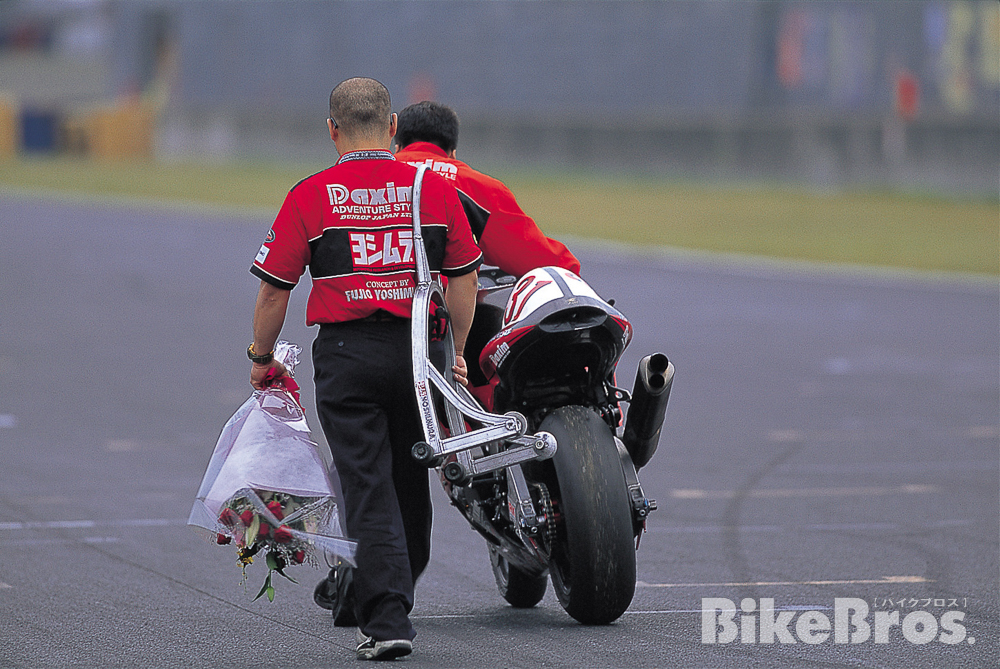
A Yosh mechanic pushing Deguchi’s bike at a 2000 All-Japan Championship race. While the large seat cowl offers an advantage in top speed thanks to its aerodynamic performance, it also has the drawback of making it easier for rivals to use the slipstream. Photo courtesy of Yoshimura Archives.
For the 2000 Suzuka 8 Hours, Yoshimura paired Deguchi with Shawn Giles. Their timed qualifying lap was 2 minutes 11.245 seconds. In the Special Stage (in which the top 20 qualifiers compete to determine the starting grid positions), they clocked a time of 2 minutes 11.329 seconds to secure the 12th grid position (3.503 seconds behind pole position). It was, of course, the top result in the S-NK class.
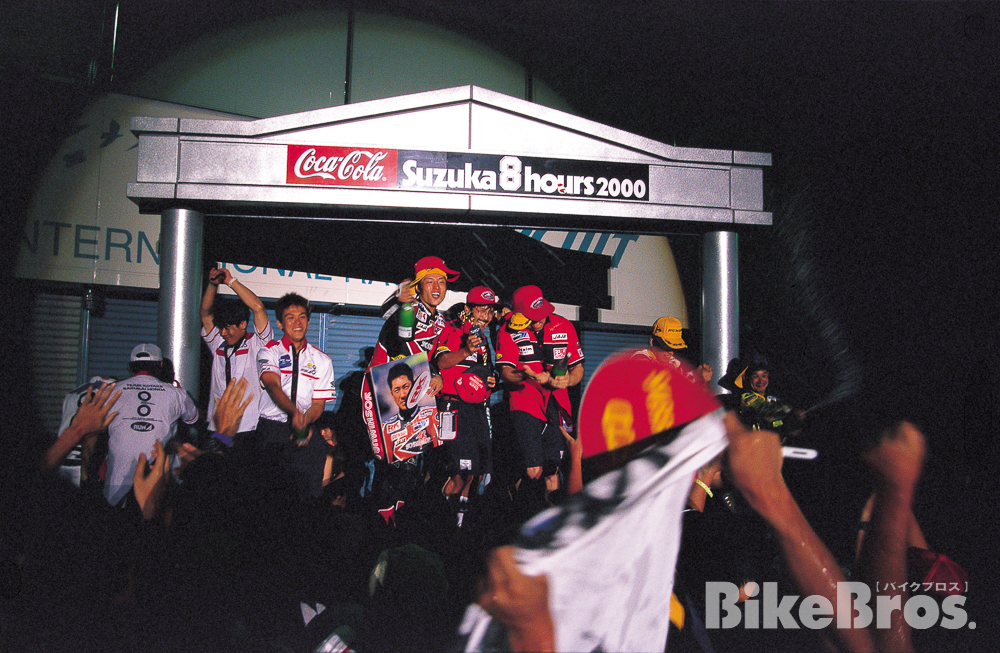
Standing on the special S-NK class podium placed in the pit area at the 2000 Suzuka 8 Hours: from left, Osamu Deguchi holding a portrait of Naoto Ogura, who passed away in March; and Fujio and Shawn Giles, overwhelmed with joy. The Yoshimura Hayabusa X-1R finished 6th overall and won the S-NK class. Photo courtesy of Yoshimura Archives.
In the 8-Hour Final, they put up a tremendous battle, finishing 6th overall after 209 laps (the winner set a new record of 215 laps) and winning the S-NK class. The S-NK victory ceremony was held not on the elevated second-floor stage where the overall awards were presented, but on a special podium set up in the pit area on the first floor. Holding the ceremony at eye level with the surging crowd was a fitting touch for the S-NK class, and Fujio, who joined the riders on the podium, was absolutely beaming. The fans’ waves of celebration responded to the best possible results achieved by freely building the bikes Yoshimura wanted to build. Winning the day, however, was the Honda VTR1000SPW –––– a 1000cc superbike with two cylinders –––– signaling the end of the 750cc four-cylinder era.
Starting with the year 2000, the Yoshimura Hayabusa race bike came to be called the X-1R. This was because Yoshimura Japan released their limited edition Yoshimura Hayabusa X-1, based on Suzuki GSX1300R Hayabusa, with only 100 units available at a price of 2.56 million yen. This marked the second street-legal complete custom bike produced by Yoshimura Japan since the 1987 Yoshimura Tornado 1200 Bonneville, which was based on the oil-cooled GSX-R1100. The X-1 was more than just a replica of the Hayabusa race bike; it was filled with the attraction and presence of a fully-fledged custom motorcycle. Above all, the eye-catching features included the fairing and 24-liter aluminum fuel tank designed exclusively by Yoshimura Japan, along with the red and black Yoshimura color scheme. The dry weight was reduced from the original 215kg to 197kg. Power was increased from the base model’s 175hp to 193hp through the use of ST-1 cams, forged high-comp pistons, cylinder head tuning (porting, resurfacing and more), an injection controller, and a Tri Oval Titanium Cyclone dual-outlet muffler. It is also equipped with a close-ratio transmission to support aggressive riding.
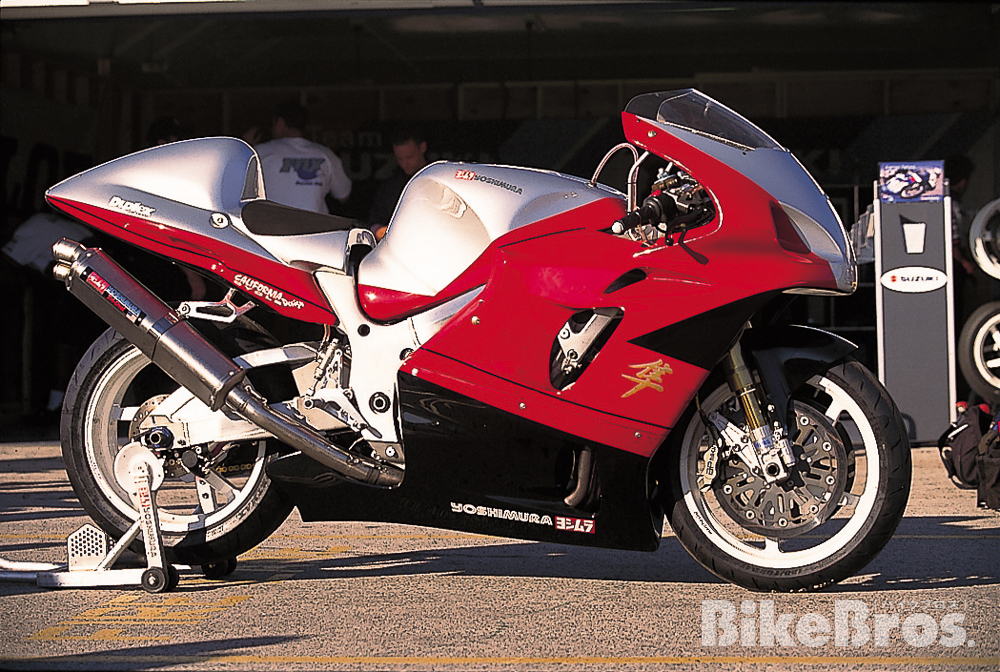
A prototype of the custom Hayabusa by Yoshimura R&D of America. Unlike the Yoshimura Hayabusa X-1, which features dual headlights, this model employs a larger single headlight positioned toward the left. The taillight also differs: while the X-1 uses Genuine Suzuki component, the Yoshimura R&D Hayabusa features a built-in unit. The 24-liter aluminum fuel tank lacks the embossed Yoshimura logo and is painted silver. The muffler is also a dual-outlet Tri Oval Titanium Cyclone, but without the tapered tailpipe covers found on the X-1. There are various other differences as well. Photo courtesy of Tomoya Ishibashi.
Yoshimura’s success with the Hayabusa in the All-Japan Championship and the Suzuka 8 Hours, as well as the release of the X-1, generated a huge response. This buzz even reached the United States, and Yoshimura R&D of America debuted its own Hayabusa-based street custom bike at Daytona Bike Week in March 2000, shortly after the X-1’s launch. Unlike the X-1, the fairing featured a styling unique to Yoshimura R&D, and the paint scheme (by California Cycle Design) incorporated silver into the red and black color scheme. The suspension is Öhlins superbike-grade front and rear, making it more high-performance than the X-1, which retained the stock suspension. The engine tuning was essentially the same as that of the X-1.
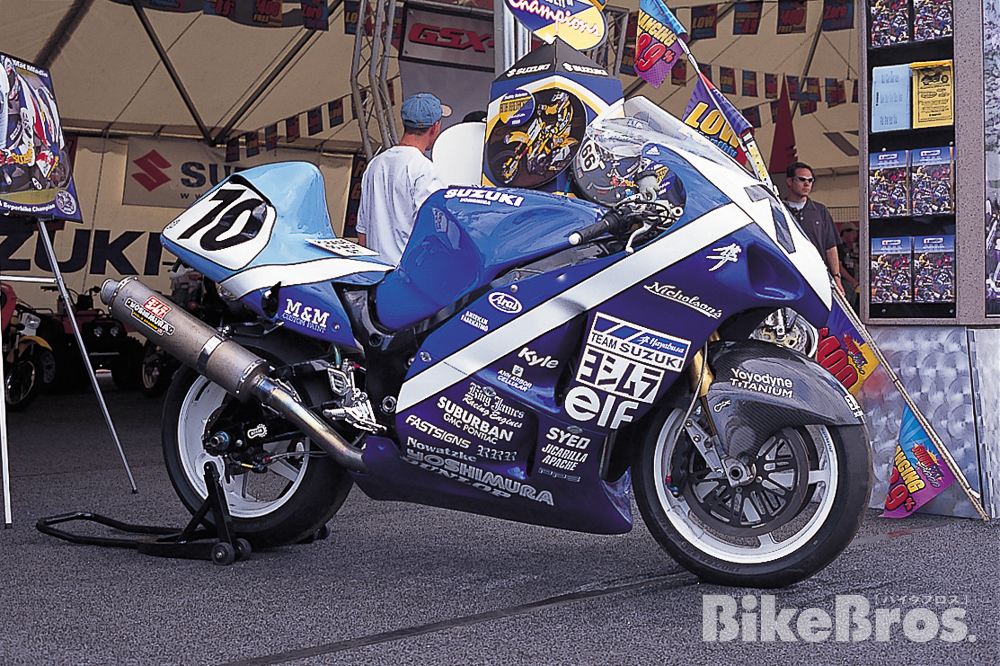
Rad Greaves’ Hayabusa racer, which earned him 6th place in the 1999 AMA Formula Xtreme standings. As a Yoshimura R&D customer, his bike featured a RS-3 titanium exhaust. Photo courtesy of Tomoya Ishibashi.
In the United States as well, the Hayabusa made a name for itself in 1999 when Rad Greaves, a Yoshimura R&D customer, finished 6th in the AMA Formula Xtreme class (745cc and up, displacement unlimited).
And so, two turbulent seasons with the Hayabusa flew by in the blink of an eye, ushering in the era of a new weapon: the GSX-R1000.
Stories and photos supplied by Yoshimura Japan / Tomoya Ishibashi
Written by Tomoya Ishibashi
Edited by Bike Bros Magazines
Published on February 18, 2026
[ Japanese Page ]