
Yoshimura history -32
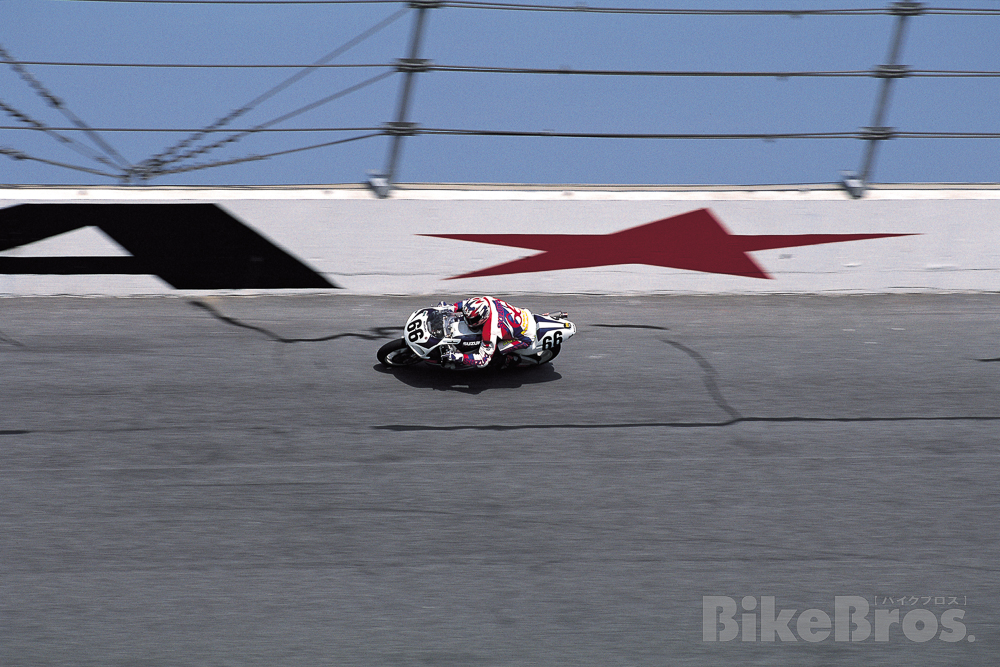
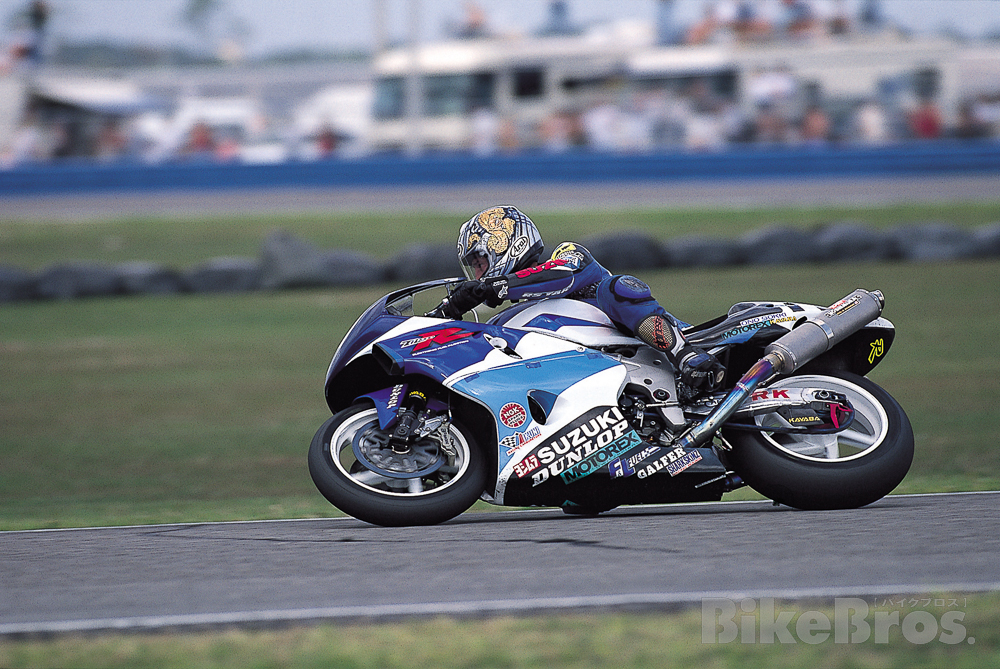
Mat Mladin at Daytona in 1998, riding the highest line of the West 31-degree bank. His style was to leave a little margin, not hugging the wall. The GSX-R750 for the 1998 AMA racing season was the conventional carburetor model; the latest EFI model was not introduced until 1999. Mladin finished 4th in this race. Photo courtesy of Tomoya Ishibashi.
Yoshimura History #32: 750 Gixxer Receives Twin-Spar Frame
1996-1998: Enter the GSX-R750 SRAD.
In 1996, the Suzuki GSX-R750 underwent a complete redesign and was reborn as the GSX-R750 Model T. Its water-cooled inline-four DOHC 16-valve engine, now in its second generation, featured a displacement of 749cc with a bore and stroke of Φ72x46mm. Compared to the Φ70×48.7mm oil-cooled and first-generation water-cooled engines, it had a shorter stroke (though longer than the Φ73×44.7mm of the 1988 oil-cooled Model J). It finally adopted a side cam chain (positioned on the right side), and the intake ports were now perfectly straight. A new SCEM (Suzuki Composite Electrochemical Material) plated cylinder was also adopted. This silicon carbide-based electroplating process alone reduced weight by 2kg compared to the previous cast iron sleeve.
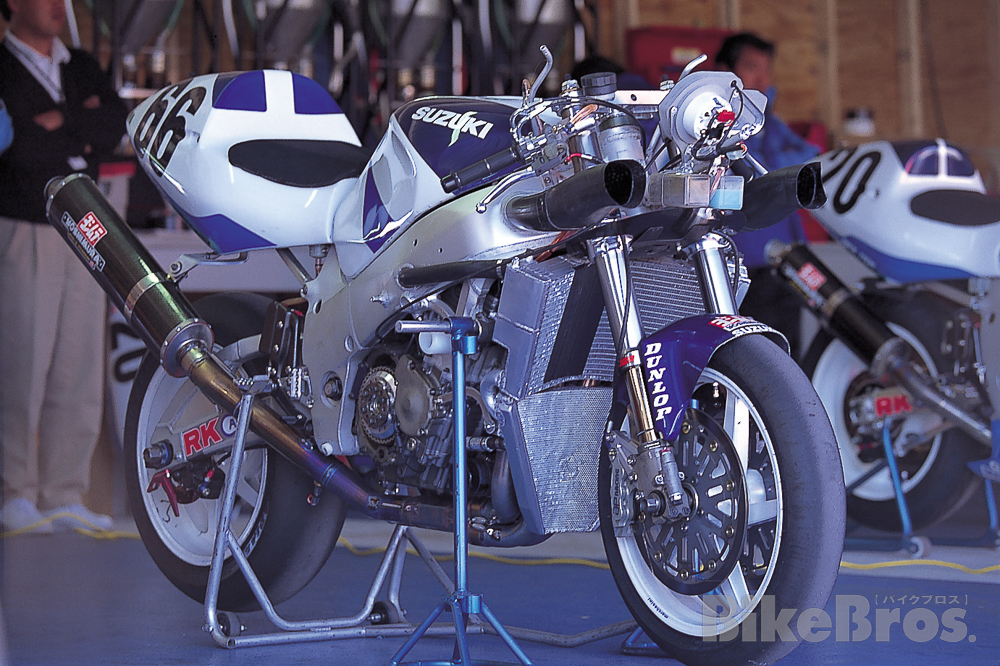
The GSX-R750 finally adopted an aluminum twin-spar frame for the 1996 model. The newly designed water-cooled engine was tilted forward 25 degrees, and the intake system became a down-draft configuration. The AMA Superbike version was a factory machine developed by Suzuki’s Hamamatsu headquarters, featuring Showa suspension front and rear, and AP Racing 6-piston front brake calipers. Even among these factory machines, various specifications existed: Scott Russell’s bike for a spot entry at Daytona and the All-Japan Superbikes both used KYB suspension front and rear, while Yoshimura’s All-Japan Superbike and Suzuka 8 Hours machines featured Öhlins suspension front and rear. Photo courtesy of Tomoya Ishibashi.
The Model T’s engine was mounted at a 25-degree forward tilt, and the intake was modified to a ram-air system dubbed SRAD (Suzuki Ram Air Direct). Fresh air drawn in through the air intakes on both sides of the upper fairing travels through ducts, passes through a large-capacity air cleaner box, and is forced into the down-draft type Mikuni BDSR Φ39mm quadruple carburetors. The engine was designed to be extremely compact. The crankcase adopted a three-piece construction, and the crankshaft and transmission were arranged in a triangular configuration, shortening the overall engine length.
The chassis evolved from the aluminum double cradle frame the GSX-R750 had previously adhered to, to an aluminum twin-spar frame. Its configuration resembled that of the Suzuki RGV-Γ500 Grand Prix racer offering high rigidity and excellent torsional balance. Within the GSX-R series, the 1988 GSX-R400 was Suzuki’s first model to adopt an aluminum twin-spar frame, but for the GSX-R750, the 1996 model was the first to adopt it.
The all-new 1996 GSX-R750 Model T –––– later known as the SRAD 750 –––– produced 130ps at 11,500rpm, with a dry weight of 179kg (same as the original 1985 GSX-R750 Model F), with a wheelbase of 1,400mm (same as the 1993 RGV-Γ500). It achieved the high output, light weight, and compactness of a racing machine all in a production motorcycle.
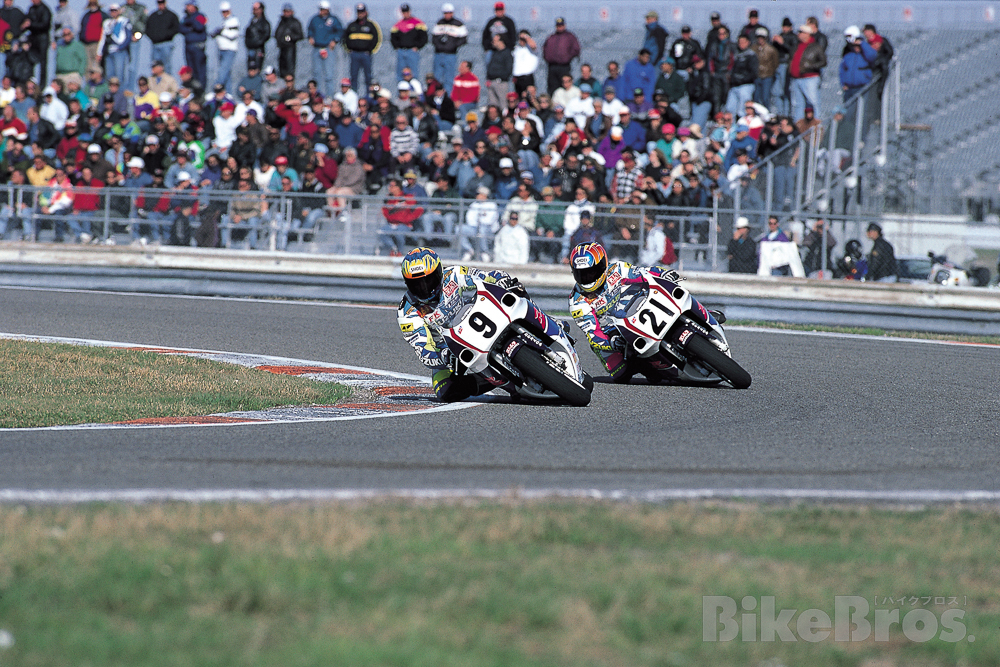
At the 1996 AMA season opener in Daytona, Yoshimura Suzuki’s #9 Aaron Yates and #21 Pascal Picotte dominated the 750 Supersport, maintaining a 1-2 formation all the way to the finish line. In this largely unmodified category, the new GSX-R750 proved its immense potential. Photo courtesy of Tomoya Ishibashi.
The Model T immediately delivered results in the 1996 AMA 750 Supersport series. Since the Supersport is a near-stock class where only the exhaust system, rear suspension, front fork inner kit (spring and piston), and footpegs (rearset) can be replaced, the base model’s performance makes all the difference. In 10 races, the Model T dominated with the factory team’s Aaron Yates winning 5 times, Pascal Picotte winning 4 times, and satellite team rider Michael Burns winning once. Yates clinched the championship, while Picotte and Burns finished 2nd and 3rd in the standings, marking a complete victory.
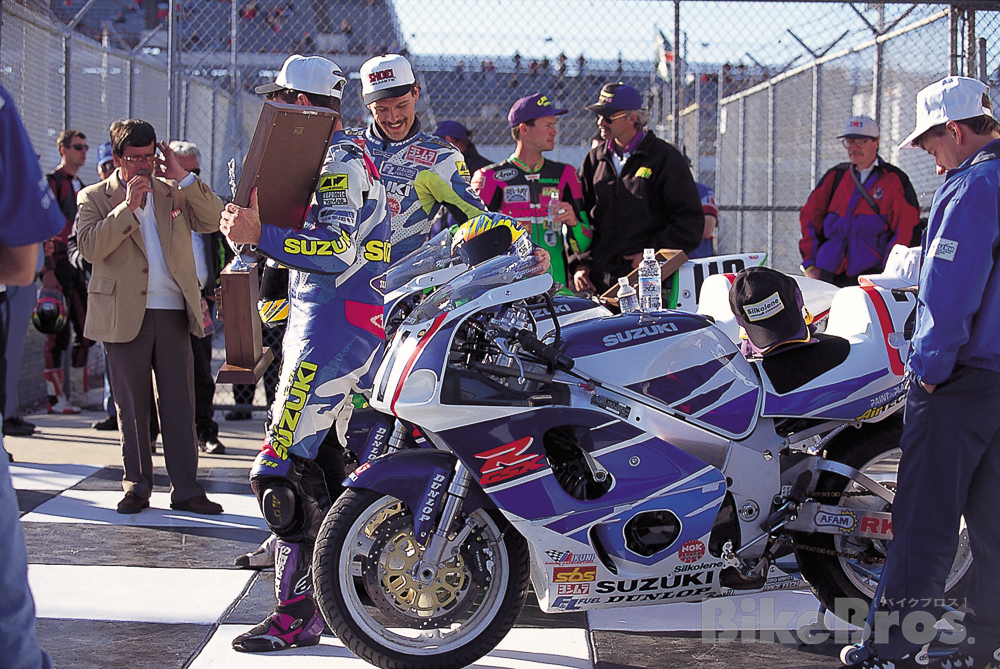
Victory Lane of the 750 Supersport race at Daytona in 1996. Pascal Picotte’s Yoshimura Suzuki GSX-R750 Model T, which finished 2nd, is in the foreground. Tires are grooved Dunlop; the front fork damper kit is Race Tech; and brake pads are SBS. The rider whose face is visible is the winner, Aaron Yates. In the background is 3rd Doug Chandler (Muzzy Kawasaki). At this time, double entries in both Superbike and Supersport (750 or 600) classes were not unusual. Photo courtesy of Tomoya Ishibashi.
Yoshimura entered the 1996 AMA Superbike season with a three-rider lineup: Picotte, Yates, and Mat Mladin. For the season opener, the Daytona 200, Scott Russell from the Suzuki 500 Grand Prix team (Lucky Strike Suzuki) joined these three for a spot race. Russell was the “Daytona Meister,” having already won the Daytona 200 three times (he would go on to win five times at Daytona by 1998), and his bike sported the same Lucky Strike color scheme as the GP team’s machines.
The final race became a match race between Russell and Miguel Duhamel riding an American Honda RC45, with Russell coming in a close 2nd place by a mere 0.01 seconds. Picotte finished 4th, Yates 7th, and Mladin 11th.
In the 1996 season, Picotte, with one win in ten races, finished 5th in the rankings. Yates, also with one win, placed 6th. Mladin, though winless, secured three podium finishes and frequent top-ten results, placing 4th overall. This represented a strong showing for the GSX-R750 Model T in its debut year.
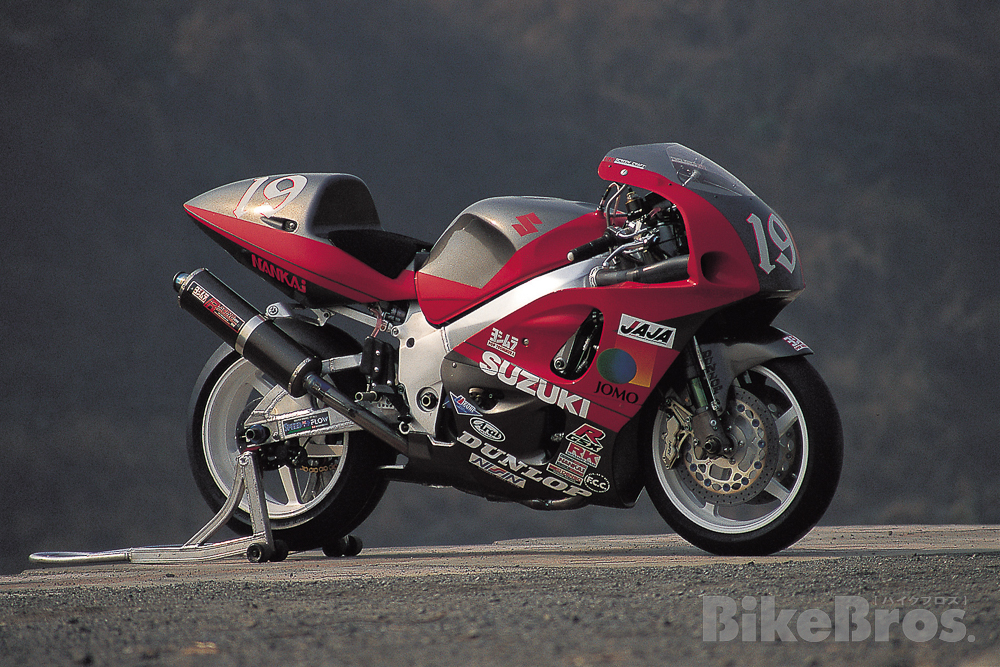
1996 Yoshimura Suzuki GSX-R750 All-Japan superbike for Tamaki Serizawa. This was the pre-season setup; for the actual races, the front and rear suspension were swapped from Showa to Öhlins. The carburetor was a Mikuni TMR40 with Yoshimura MJN. The Suzuki factory machine also equipped MJN kit, though its specifications differed. Photo courtesy of Yoshimura Archives.
In the 1996 All-Japan Superbike Championship, Yoshimura fielded Tamaki Serizawa for the second consecutive year. However, they struggled with tuning the Model T, and Serizawa was unable to fully master the machine, finishing 11th in the standings. Suzuki Factory fought hard, with Katsuaki Fujiwara securing 2nd place in the rankings.
In the 1996 Suzuka 8 Hours, Yoshimura fielded Tamaki Serizawa / Toshiyuki Hamaguchi, finishing 12th. Suzuki Factory saw Katsuaki Fujiwara / Akira Ryo of Lucky Strike Suzuki finish 6th, Doug Polen / Juan-Éric Gomez of SERT (Castrol Suzuki) finish 9th (Polen returned to Suzuki in 1996), and Kirk McCarthy / John Reynolds of SBK (Suzuki WSB) finish 10th. The highly anticipated Lucky Strike Suzuki duo of Scott Russell / Terry Rymer ended their race with a retirement.
The most notable achievement in the SRAD 750’s second year, 1997, was its perfect 10-for-10 victory streak in the AMA 750 Supersport series. Jason Pridmore (son of 1976-1978 AMA Superbike Champion Reg Pridmore) secured the championship with eight wins. The remaining two wins went to Mario Duhamel and Doug Polen, who had returned to Suzuki in 1996.
Picotte and Yates competed in the 1997 AMA 600 Supersport series with the new GSX-R600 from Suzuki Factory. Picotte won four of the ten races but finished a close 2nd in the standings, just 6 points behind. Yates won twice and finished 3rd. The champion was Honda’s Miguel Duhamel, who won four races.
The Suzuki GSX-R600 features a bore of 65.4mm and stroke of 44.5mm (599.5cc), which is 6.5mm smaller in bore and 1.5mm shorter in stroke compared to the GSX-R750 Model T. Visually, it differs from its 750 sibling only in having conventional Φ45mm forks instead of inverted Φ43mm forks, with no significant reinforcement to the swingarm. The Mikuni BDSR carburetor was downsized from Φ39mm to Φ36mm. Dry weight was 174kg compared to the 750’s 179kg, wheelbase was 1,390mm versus the 750’s 1,400mm, and maximum output was 106ps compared to the 750’s 130ps. This resulted in a lightweight, compact, high-power supersport model.
The AMA 600 Supersport class became the national championship in 1987. It was held as a World Series in 1997 and 1998, and starting in 1999, it was elevated to a world championship, running concurrently with the SBK (FIM Superbike World Championship). It subsequently became the core of unmodified production racing.
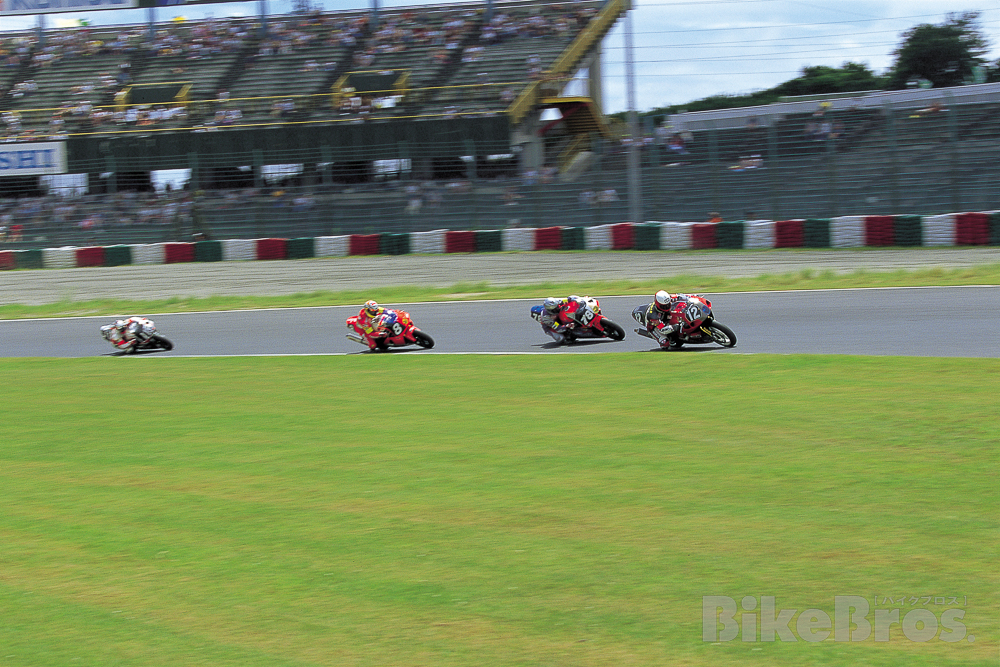
1996 Suzuka 8 Hours, near Turn 2. Leading the pack is Serizawa on the #12 Yoshimura Suzuki GP-1 Plus GSX-R750. Following him were Haruchika Aoki (the third son of the Aoki brothers, paired with his eldest brother Nobuatsu) on the #78 Ultraman RT Sakurai Honda RC45, Akira Ryo on the #8 Kawasaki RT ZX-7RR, and Aaron Slight on the #11 Castrol Honda RC45. Photo courtesy of Osamu Kidachi.
In 1997, Yoshimura Suzuki finished the AMA Superbike season without a win, with Yates ranked 5th, Picotte ranked 6th, and Flat Track superstar Larry Pegram, who had switched to road racing, ranked 8th.
In the All-Japan Superbike series, Serizawa ranked 8th. Yoshiteru Konishi, who made a one-off appearance in the Suzuka 200km to prepare for the Suzuka 8 Hours, finished 15th to earn one point, placing him 39th overall. Suzuki Factory rider Katsuaki Fujiwara performed superbly, securing 2nd place in the standings.
The 1997 Suzuka 8 Hours, a wet race, saw Serizawa / Konishi momentarily running in 3rd position. However, Konishi made contact with Honda Factory rider Alexandre Barros, who was closing in, causing only Konishi to crash. After repairs in the pits, the Yoshimura Suzuki restarted, but crashed again and was forced to retire.
Among the Suzuki teams other than Yoshimura at the Suzuka 8 Hours, Lucky Strike Suzuki’s Peter Goddard and Doug Polen performed well, finishing in 5th place. The pair went on to win the EWC (FIM Endurance World Championship) title. With this, Polen has won the SBK World Championship (1991 Ducati, 1992 Ducati), the EWC World Championship (1997 Suzuki, then moved to Honda in 1998 to win back-to-back titles), the AMA Superbike Championship (1993 Ducati), the All-Japan TT-F1 & F3 Championship (1989 Yoshimura), Suzuka 8 Hours (1994 Honda). He has now conquered the world’s major titles/races of 4-stroke motorcycles, excluding the Daytona 200.
Yoshimura’s Larry Pegram riding the Suzuki TL1000R at the Daytona infield in 1998. Although this TL1000R was a factory machine built by Suzuki headquarters, it suffered from a lack of power, partly because the larger EFI throttle bodies permitted in SBK were not allowed in AMA races. Photo courtesy of Tomoya Ishibashi.
In 1998, the GSX-R750 was upgraded to become the Model W. It switched from a BDSR Φ39mm carburetor to EFI, and the throttle body equipped with a butterfly valve was Φ46mm, a size unattainable with a carburetor. The EFI control system employed a two-stage setup: at low rpm, it primarily calculated the air-fuel ratio based on engine rpm and intake manifold pressure; as rpm and load increased, it primarily calculated it based on engine rpm and throttle opening. Ignition was by direct CDI ignition coil. Furthermore, the cylinder cooling passages changed from open-deck design to closed-deck design, increasing cylinder rigidity. Numerous other improvements were made, including weight reduction in various components, modified cam profiles, and a new close-ratio gearbox.
Another new machine joined Suzuki’s AMA Superbike lineup alongside the Gixxers: the TL1000R. This ambitious machine features a 996cc water-cooled 90-degree V-twin with a bore and stroke of Φ98×66mm, mounted in an aluminum twin-spar frame, to comply with Superbike regulations limiting four-cylinders to 750cc and two-cylinders to 1000cc. The DOHC EFI engine boasts four valves and two injectors per cylinder, delivering an encouraging 135ps at 9,500 rpm.
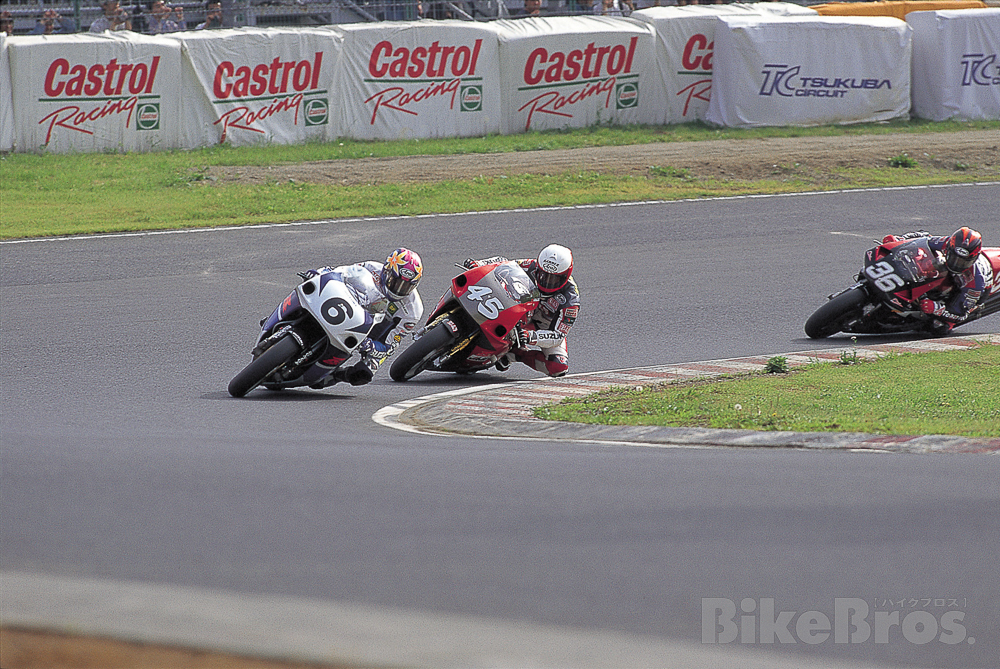
At the 1998 All Japan Championship, #45 Hamaguchi on the carbureted Yoshimura GSX-R750 battled #6 Ryo on the fuel-injected Suzuki Factory GSX-R750. Behind them is privateer #36 Takahiro Sohwa riding a Honda RC45. Photo courtesy of Osamu Kidachi.
However, in AMA racing, homologation for the GSX-R750 Model W was delayed by one year to 1999. Also, Yoshimura, competing in the All-Japan Championship and Suzuka 8 Hours, deliberately chose a carburetor setup combining Mikuni TMR Φ40mm with MJN for its maturity, while Suzuki Factory (Keiichi Kitagawa, Akira Ryo) opted for EFI. Suzuki Factory’s Atsushi Watanabe, meanwhile, competed on a TL1000R for the first half of the season for development purposes (switching to the GSX-R750 for the second half).
For the 1998 AMA Superbike series, Yoshimura fielded Mladin and Yates on the conventional carbureted GSX-R750, and Pegram and Steve Crevier on the new TL1000R. The season saw Mladin finish 3rd in the standings with one win, while Yates ended 5th with two wins. Crevier fought well to finish 7th overall, narrowly missing the podium with one 4th-place finish and securing a top-10 finish in 9 of 13 races. Pegram finished 10th in the standings.
Yoshimura Suzuki continued its factory participation in the 1998 AMA 600 Supersport series. Although Crevier finished with just one win in 13 races, he consistently placed in the top ranks at every event, brilliantly securing his first-ever AMA championship. Pegram finished 8th in the standings, while Yates, who scored two wins, placed 10th. Nicky Hayden, before joining American Honda, competed on a HyperCycle Suzuki GSX-R750, securing one win and finishing 4th in the standings. The 750 Supersport series was dominated by privateers, with Richard Alexander, who scored one win, claiming his first title. Nicky Hayden, who recorded the most wins with five, finished 4th in the standings.
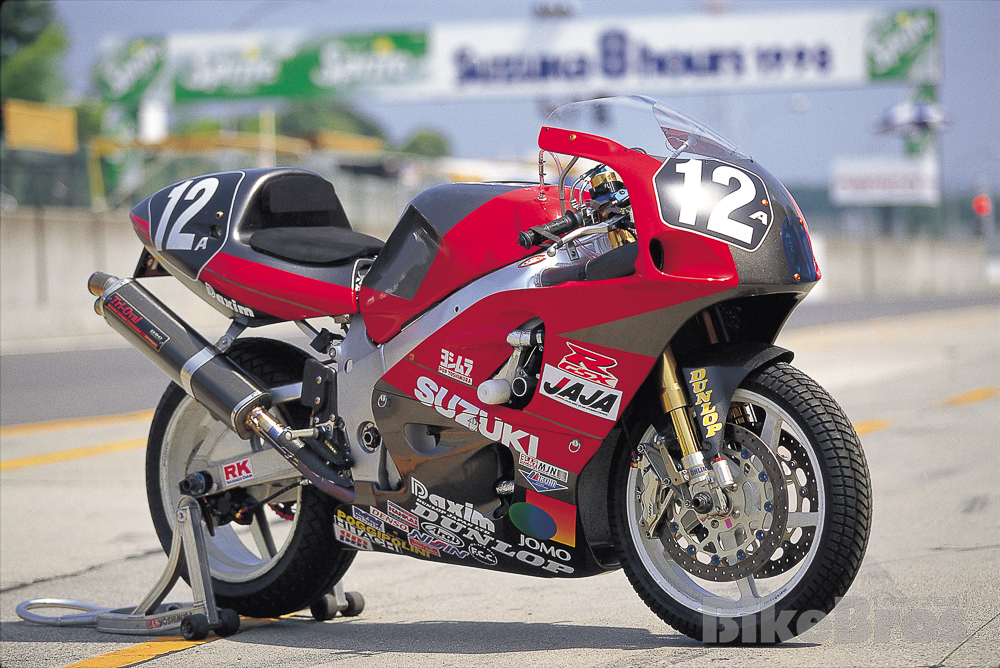
The Yoshimura Suzuki GSX-R750 for 1998 Suzuka 8 Hours. The Mikuni TMR Φ40mm + Yoshimura MJN carburetor setup was deliberately chosen. Suspension features Öhlins front and rear. Front brake calipers are 6-piston Nissins. Rain tires fitted front and rear for travel (transportation) purposes. Photo courtesy of Osamu Kidachi.
In the 1998 All-Japan Superbike series, Yoshimura fielded Hamaguchi, who got off to a strong start with a 5th place finish at the opening round in Motegi. However, this was his best result of the season, and he ended the year ranked 9th. In the Round 4 Suzuka Superbike 200km race, positioned as a prelude to the Suzuka 8 Hours, Yoshimura’s Naoto Ogura made a spot appearance to prepare for the midsummer showdown, finishing 11th and earning 5 points.
In the 1998 Suzuka 8 Hours, Yoshimura challenged with Hamaguchi and Ogura. Starting rider Hamaguchi put up a strong battle against the factory teams, handing over to Ogura. However, just 10 laps after the changeover, engine trouble forced a pit stop, ending their race in retirement.
Then in 1999, Yoshimura embarked on a new challenge for All-Japan and Suzuka 8 Hours. It was an unlimited battle, free from convention, where machines were built without restraint.
Stories and photos supplied by Yoshimura Japan / Osamu Kidachi / Tomoya Ishibashi
Written by Tomoya Ishibashi
Edited by Bike Bros Magazines
Published on June 23, 2025
[ Japanese Page ]